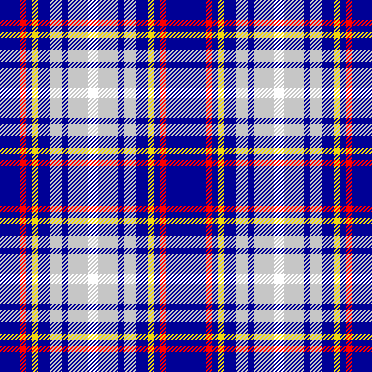
Blue represents one of the state colors of Nevada, the pristine waters of Lake Tahoe and the mountain bluebird, the official state
bird;
Silver represents the other state color, the official state mineral, the granite composition of the Sierra Nevada mountain range and
the silver country of northern Nevada;
Red represents the Virgin Valley black fire opal, the official state precious gemstone, and the red rock formations of southern
Nevada;
Yellow represents sagebrush, the official state flower, and symbolizes the great basin region of central Nevada;
White represents the name of this state meaning snow-covered, which is the translation of the Spanish word “nevada”;
The crossing of the yellow and red stripes represents the different colors of Nevada sandstone, the official state rock;
The white intersection on the silver field stands for the snow-capped peaks of granite mountains, which make up the Sierra Nevada
mountain range;
The four blue lines represent the four main rivers of Nevada which are the Colorado River, Truckee River, Humboldt River and
Walker River;
The intersecting blue lines in the silver field represent the Colorado River as it meets Hoover Dam and creates Lake Mead;
The small solid “boxes” of silver and blue number 8 by 8, or 64, to signify the year (1864) that Nevada was admitted into statehood;
The 13 solid-colored intersections of the small stripes represent Boundary Peak, the highest point in Nevada, which stands at an
elevation of 13,143 feet; and
The 16 solid silver intersections and the solid white intersection in the center of the tartan represent the 16 counties and the one
consolidated city-county government of Nevada.
Nevada State Tartan Sett Threadcount
Gray
18
Dark Blue
8
Gray
32
White
14
Gray
32
Dark Blue
8
Gray
18
Dark Blue
18
Gold
8
Dark Blue
18
Red
8
Dark Blue
64
Red
8
Dark Blue
8
Gold
8
Dark Blue
18
Link to the Official Nevada State Tartan Legislation site at Nevada Senate Bill SB347
www.ziggy1.com copyright
© 1997-2009
Last revised:April 15, 2009